
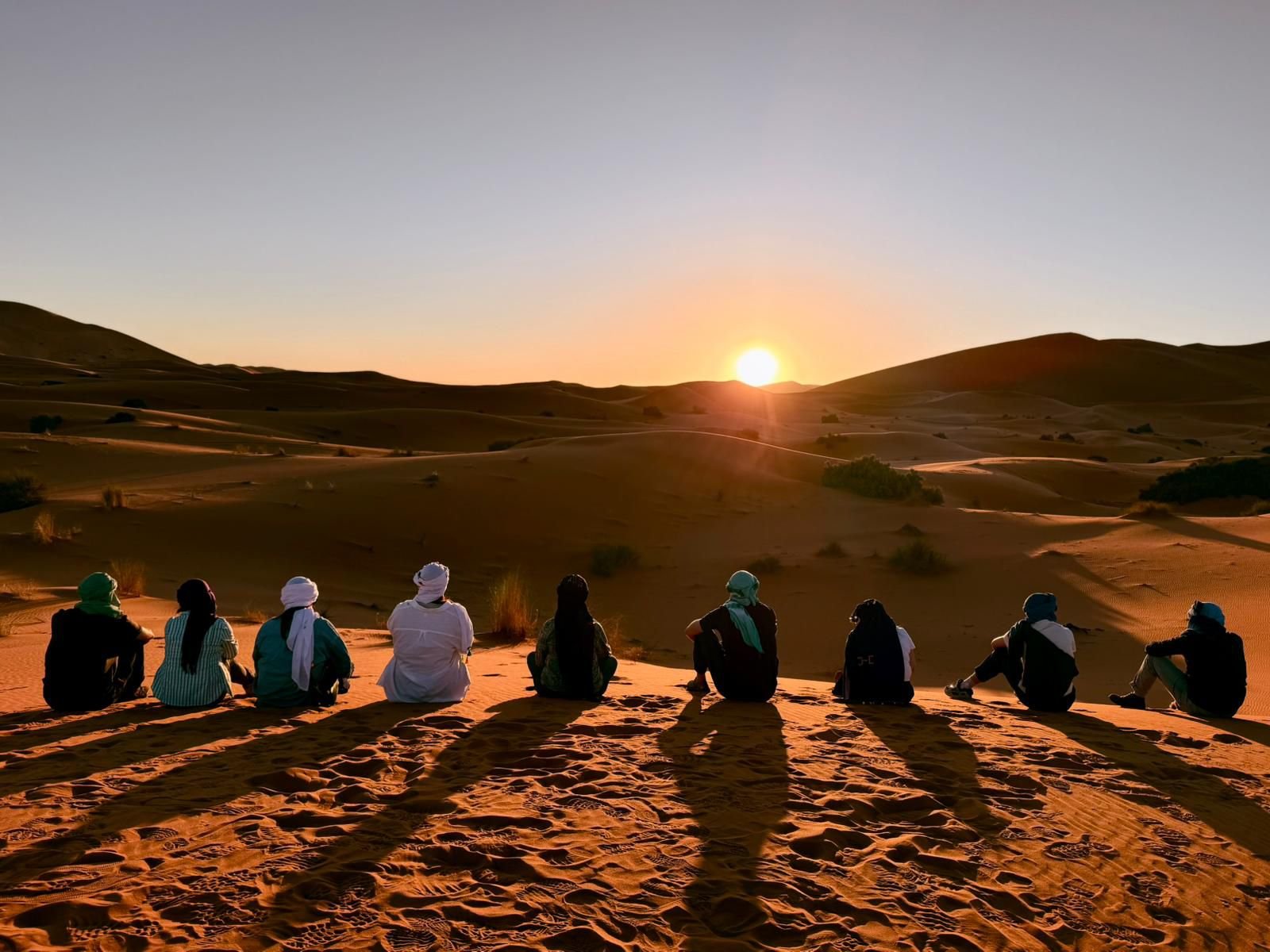
A Sahara desert tour in Morocco is mostly a road trip with one or two nights in the dunes. Expect long drives across the High Atlas, stops at kasbahs, gorges and palm valleys, a camel ride of about an hour at sunset, dinner and music at a tented camp, and an early start for sunrise.
Which desert: Merzouga, Zagora or Agafay
Three places are sold as "the desert" from Marrakech, and they are very different. Knowing which one you are booking avoids disappointment.
| Area | Distance from Marrakech | Minimum time | What you get |
|---|---|---|---|
| Merzouga (Erg Chebbi) | About 560 km, 9–10 hours' driving | 3 days | High orange sand dunes, up to roughly 150 m |
| Zagora | About 350 km, 6–7 hours' driving | 2 days | Draa Valley palm groves, rocky desert and small dunes |
| M'Hamid (Erg Chigaga) | About 450 km plus a 4x4 track | 3–4 days | Large remote dunes, far fewer visitors |
| Agafay | About 40 km, under 1 hour | Half a day | Stony hills, no sand dunes |
If you picture tall, rolling dunes, you want Merzouga. Zagora suits travellers with only two days, as on the 2-day tour from Marrakech to Zagora. Agafay is pleasant for a dinner or a night out of the city, but it is not the Sahara.
The route, day by day
The classic three-day trip from Marrakech to Merzouga and back follows one main road east. Most of the first two days are spent travelling, with regular stops.
- Day 1, Marrakech to Dades Valley: cross the High Atlas over the Tizi n'Tichka pass at 2,260 m, visit the fortified village of Ait Ben Haddou, pass Ouarzazate and the rose-growing valley around Kelaat M'Gouna, and sleep in the Dades Valley. Around 7 hours of driving.
- Day 2, Dades to Merzouga: walk in the Todra Gorge, where the cliffs rise close to 300 m, continue through Tinghir and Erfoud, reach the dunes in the late afternoon, and ride camels to camp. Around 5 hours of driving.
- Day 3, Merzouga to Marrakech: sunrise on the dunes, breakfast, then the long drive back, about 9–10 hours with stops.
The return day is the hard one. A fourth day makes the trip much more comfortable, and finishing in Fes instead of returning avoids repeating the road. See the 3-day desert tour from Marrakech to Merzouga for the full schedule.
The camel ride and getting to camp
Camps sit inside or at the edge of the dunes. You leave your main luggage in the vehicle or at a hotel on the edge of the erg and take a small bag for the night. The camel ride usually lasts 45 minutes to 1 hour 30 minutes, timed to reach a high dune for sunset.
Camels walk slowly, led on foot by a handler. Getting up and down is the awkward part: lean back as the animal stands and hold the handle. Long trousers help. If you prefer not to ride, or have back trouble, camps can be reached by 4x4 instead. Tell your operator in advance.
What desert camps are like
Camps fall into two broad categories.
- Standard camps: canvas or wool tents with proper beds, mattresses and blankets. Toilets and showers are in a shared block. Simple and comfortable enough for one night.
- Luxury camps: large private tents with a private bathroom, hot shower, flush toilet, electric lighting and sockets. Some have heating or air-conditioning.
In both, dinner is served in a communal tent: usually soup or salad, a tagine with bread, and fruit. Afterwards the staff play drums around a fire. Light pollution is very low, so on a clear, moonless night the stars are the main event. Phone signal is patchy and Wi-Fi is not something to count on. Our guide to choosing a desert camp in Merzouga or Zagora explains the differences in more depth.
Weather: heat, cold and wind
The desert has extreme swings. In Merzouga, daytime highs are typically around 17–20°C in January and over 40°C in July and August. Nights in December and January can fall to around freezing, while summer nights stay near 25°C or above.
The most comfortable months are March to May and late September to November, with warm days and cool nights. Spring can bring wind and occasional sandstorms, which usually pass within hours. In midsummer, activities shift to early morning and late evening, and some travellers find the heat too much. For monthly detail, see Merzouga weather by month.
What to bring and wear
- A warm jacket or fleece from October to April, plus socks for the night
- A scarf or cheche to cover head and face against sun and blowing sand
- Sunglasses, sunscreen and lip balm
- Sandals for the sand and closed shoes for gorge walks
- A torch or headlamp, and a power bank
- Cash in dirhams for drinks, tips and small purchases, since there are few ATMs after Erfoud and Rissani
- Motion sickness tablets if mountain roads affect you
Water is provided or sold at every stop. Drink more than you think you need, because dry air hides how much you sweat.
Private or shared tour, and other things to decide
Shared group tours run in minibuses with fixed stops and a fixed timetable. They cost less, but the pace is set for the group. A private tour gives you your own vehicle and driver-guide, the freedom to stop for photos or skip a place, and a choice of accommodation level. For families, couples and anyone who wants shorter driving days, private usually works better.
Extras that can be arranged at the dunes include sandboarding, quad or buggy rides, a 4x4 circuit to nomad families and the village of Khamlia, known for Gnawa music, and a second night in camp. A second night is the single best upgrade if you have the time: it gives you a full day in the dunes without a drive. You can also start from the north, with desert tours from Fes reaching Merzouga in about 7–8 hours.
Frequently asked questions
How many days do you need for a Sahara desert tour from Marrakech?
At least three days to reach the big dunes at Merzouga and return. Four days is more relaxed, and two days only gets you as far as Zagora.
Is the camel ride uncomfortable?
It is fine for about an hour, though some people feel it in their thighs and lower back afterwards. A 4x4 transfer to camp is available as an alternative.
Are there toilets and showers in desert camps?
Yes. Standard camps have shared toilets and showers, and luxury camps have a private bathroom with hot water in each tent.
Can children go on a Sahara tour?
Yes, children usually love the dunes. The challenge is the driving, so choose a private tour with extra stops and consider four days instead of three.
Tell us your dates and group size, and Discover Morocco Tour will send a free custom quote within 24 hours.