
The Marrakech souks are a maze of specialised markets north of Jemaa el Fnaa. Shop in the morning, check fixed-price references first, counter at around a third to half of the first price and pay in cash.
Marrakech souks shopping means exploring a labyrinth of covered markets north of Jemaa el Fnaa, each traditionally dedicated to one craft: leather, spices, lanterns, carpets, metalwork or textiles. The keys to a good experience are simple: go in the morning, know the approximate fair price before you start, haggle with a smile and walk away if the price does not suit you. This guide lists the main souks, the best things to buy, realistic price ranges and our guides' haggling method.
The main souks of Marrakech and what each sells
The souks occupy the area between Jemaa el Fnaa and the Ben Youssef Madrasa, inside the Medina of Marrakesh, a UNESCO World Heritage Site. Specialisation is less strict than in the past, but the old names still guide you.
- Souk Semmarine: the wide main artery, with textiles, kaftans, slippers and souvenirs. Prices start high here.
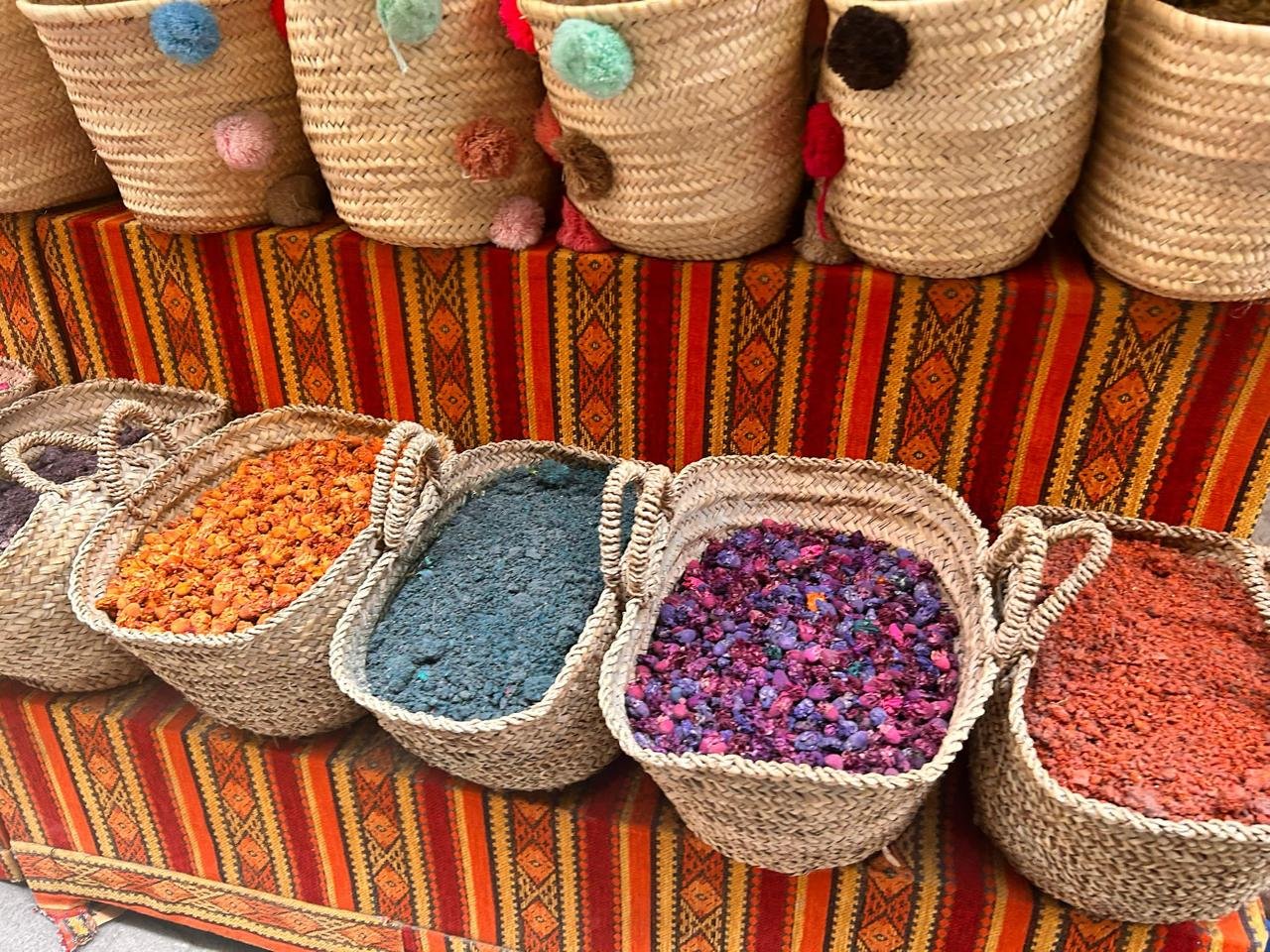
- Rahba Kedima (Place des Épices): an open square with spices, herbal remedies, baskets and straw hats, surrounded by café terraces.
- Souk el Attarine: perfumes, essential oils, brass and copper goods.
- Souk Haddadine: the blacksmiths' quarter, where you can watch lanterns and metal furniture being made.
- Souk des Teinturiers: the dyers' souk, with skeins of coloured wool drying overhead.
- Souk Cherratine: leather workshops making bags, belts and poufs.
- Criée Berbère: the old carpet auction area, still home to many rug dealers.
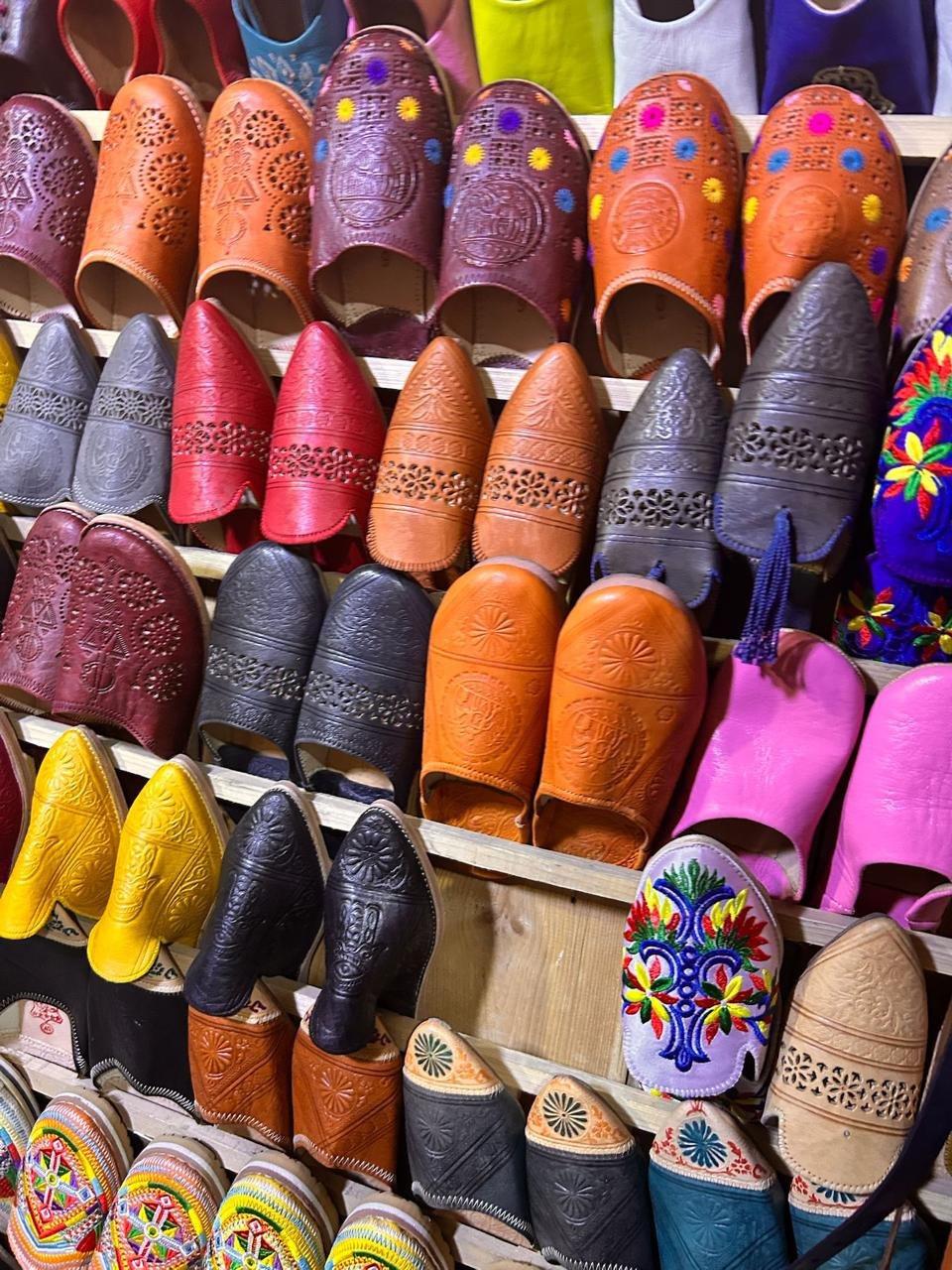
- Babouche souk: rows of leather slippers in every colour.
What to buy in Marrakech
Rugs and carpets
Morocco's most famous purchase. Beni Ourain rugs (cream wool with dark geometric lines) come from the Middle Atlas, Azilal rugs are colourful and playful, kilims are flat-woven, and boucherouite rugs are made from recycled fabric. Real hand-knotted wool feels dense and the pattern is visible on the back. Large rugs are a serious investment; take your time and ask about shipping.
Leather goods
Babouches, bags, poufs, jackets and belts. Smell and touch the leather; good leather is supple, with even stitching and finished edges. Note that the strong smell of some goods fades after a few weeks.
Lanterns and metalwork
Pierced brass, copper or iron lanterns cast beautiful shadows. Check soldering joints and ask for them to be wrapped well for your flight.
Ceramics, spices, argan and cosmetics
Painted plates and tagines (decorative ones are often not food-safe; ask), ras el hanout spice blends, saffron (buy little and from trusted shops), black soap, rose water and argan oil. For pure argan, buying from a women's cooperative is often more reliable; see our argan oil cooperative guide.
Fair prices in the Marrakech souks
Prices depend on quality, size and your bargaining skills. The table gives approx. ranges our guides consider fair for decent mid-range quality in 2026, after haggling; first asking prices are often two to four times higher. One euro is roughly 10-11 MAD.
| Item | Approx. fair price (MAD) | Approx. in EUR |
|---|---|---|
| Leather babouches | 100-250 | 10-25 |
| Leather pouf (unstuffed) | 250-500 | 25-50 |
| Leather bag (medium) | 350-900 | 35-90 |
| Small brass or iron lantern | 150-400 | 15-40 |
| Hand-painted ceramic bowl | 50-150 | 5-15 |
| Ras el hanout (100 g) | 30-80 | 3-8 |
| Cosmetic argan oil (100 ml, pure) | 150-300 | 15-30 |
| Small Berber rug or kilim (approx. 1 x 1.5 m) | 1,500-5,000 | 140-470 |
These figures are indicative and vary a lot with quality, so check before buying and compare a few shops.
How to haggle in Marrakech: our guides' method
Haggling is expected in the souks and is part of the social experience. It should be friendly, never aggressive. Here is the method we share with our travellers.
- Look first, buy later: take a first walk without buying to compare quality and prices.
- Check a fixed-price reference: the Ensemble Artisanal on Avenue Mohammed V, near the Koutoubia, shows fixed prices for good crafts.
- Let the seller name a price first, then counter at around a third to half of it, depending on how high it seems.
- Stay relaxed and polite: accept the mint tea if offered; it does not oblige you to buy.
- Never name a price you would not pay: if the seller accepts, you are expected to buy.
- Bundle items: buying several pieces in one shop gives you more leverage.
- Walk away kindly: often the best price comes as you leave. If not, there are many similar shops.
A useful phrase: bshhal? (how much?), and ghali bezzaf (too expensive), always with a smile.
Cash and payment
Small shops prefer cash in dirhams; ATMs are around Jemaa el Fnaa and in Guéliz. Larger shops accept cards, sometimes with a surcharge. Read our Morocco currency and money tips before you go.
Common traps in the souks
- The helpful stranger: someone says a road is closed or offers to show you the tannery or a special Berber market today only. This leads to a commission shop.
- Commission guides: unofficial guides earn 20-40% of what you spend. A licensed guide booked in advance works for you, not for shops.
- Fake materials: synthetic dyes sold as natural, faux leather, coloured saffron, diluted argan oil.
- Shipping promises: for expensive rugs, get a written receipt detailing size, price and shipping terms.
- Protected species: avoid tortoise shells, animal skins and antiquities, which are illegal to export.
The square next door has its own tricks; see our Jemaa el Fnaa guide for the classics there.
Best time to shop and practical tips
- Most shops open around 9:30-10 am and close around 7-8 pm; some close on Friday around midday prayer.
- The first sale of the morning is considered lucky, and sellers are often more flexible.
- Download an offline map, but also note landmarks: the Ben Youssef Madrasa, Rahba Kedima and Jemaa el Fnaa.
- Watch for motorbikes and handcarts in narrow alleys; step aside when you hear balak (watch out).
- Wear comfortable shoes and keep your bag in front of you.
Shopping with a private guide
A licensed city guide saves time, takes you to workshops where artisans actually work and helps you judge quality, without the hard sell. We organise guided medina visits within our Morocco private tours, and a souk morning combines easily with an afternoon on one of our day trips from Marrakech, for example to see argan cooperatives on the Essaouira road.
Planning a trip with some time for shopping? Contact our Marrakech team for a free quote and we will build an itinerary around your interests within 24 hours.
Frequently asked questions
How much should you haggle in Marrakech?
A good rule is to counter at around a third to half of the first price, then meet somewhere around half to two-thirds of it. There is no fixed percentage: tourist-heavy streets start higher, quality pieces have less margin. Decide your maximum before starting, stay friendly and be ready to walk away. Comparing prices at the fixed-price Ensemble Artisanal first helps a lot.
What is the best thing to buy in the Marrakech souks?
The most popular buys are leather babouches, Berber rugs, lanterns, ceramics, spices such as ras el hanout and cosmetics like black soap and argan oil. For quality and value, rugs and leather goods are the star purchases, but take your time. Small items like spices, soap and slippers are easy to carry and make good gifts.
Are the Marrakech souks open on Fridays?
Yes, most of the souks are open on Fridays, though some shops close for a few hours around the midday prayer, roughly between 12 and 3 pm, and some owners take the whole day off. The souks are generally busiest on weekend afternoons and quietest in the morning, which is the best time to browse and bargain calmly.
Can I pay by card in the Marrakech souks?
Larger shops, especially carpet and furniture dealers, usually accept cards, sometimes with a fee of a few percent. Most small stalls only accept cash in Moroccan dirhams. Carry small notes and coins, because sellers may not have change for 200 MAD notes. Withdraw money from bank ATMs rather than exchanging in the souk.