
Jemaa el Fnaa is Marrakech's main square and a UNESCO-listed masterpiece of oral heritage. Go late afternoon for sunset and the food stalls, carry small change and politely decline photos with animals.
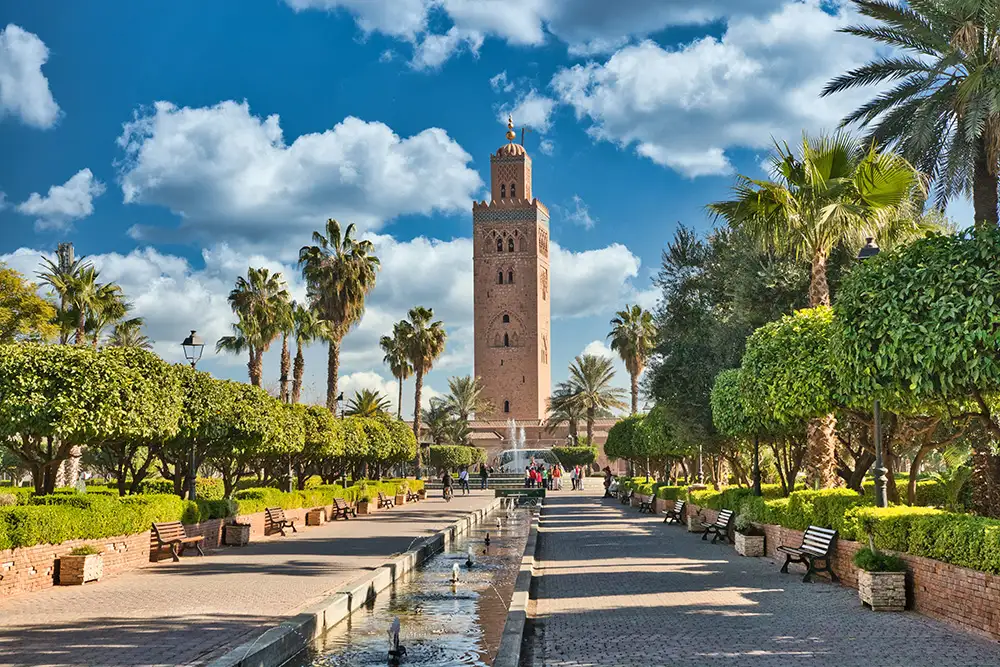
Jemaa el Fnaa is the great open square at the heart of the Marrakech medina, a few hundred metres from the Koutoubia Mosque, where storytellers, musicians, juice sellers and open-air food stalls have gathered for centuries. The best time to visit Jemaa el Fnaa is from about 5 pm, when the food stalls set up and the sunset lights the square; come back again in the morning to see it calm. This guide covers its history, what to eat, the scams to avoid and how our guides plan a visit.
What is Jemaa el Fnaa? A short history
The square dates back to the founding of Marrakech by the Almoravids in the 11th century, and it has been the city's public stage ever since: a market, a meeting place for caravans arriving from the Sahara and the Atlas, and a space for public announcements. The meaning of the name is still debated. The most common translation is assembly of the dead, possibly linked to public executions in past centuries, while another theory refers to a mosque project that was never completed.
What makes Jemaa el Fnaa unique is not its architecture, which is rather plain, but its living culture. The Spanish writer Juan Goytisolo, who lived nearby, campaigned to protect the square's oral traditions, and in 2001 UNESCO proclaimed the Cultural Space of Jemaa el-Fna Square a Masterpiece of the Oral and Intangible Heritage of Humanity, the very first of these proclamations. It is now on UNESCO's Representative List of Intangible Cultural Heritage, and it lies within the Medina of Marrakesh, a UNESCO World Heritage Site since 1985.
The halqa: circles of performers
Look for the halqa, the circles of people gathered around a performer. You will see Gnawa musicians with their iron castanets (qraqeb), acrobats, traditional healers, and the last storytellers (hlaiqia) reciting tales in Darija. Even without understanding a word, the atmosphere is captivating. A coin of 5 to 10 MAD is the polite thing to give if you stay and watch.
Best time to visit Jemaa el Fnaa
The square changes completely throughout the day, so in our experience the ideal is to pass through at least twice. Most of our travellers stay in a riad within 10 to 15 minutes' walk, which makes this easy.
| Time of day | What you will see | Our tip |
|---|---|---|
| 9 am - 12 pm | Fresh orange juice carts, dried fruit sellers, calm square | Best moment for photos without crowds and for entering the souks |
| 12 pm - 4 pm | Hot and quieter in summer, henna artists and water sellers | Skip in July-August (often 38-45°C); rest in your riad |
| 4 pm - 6 pm | Food stalls being assembled, musicians arrive | Grab a terrace table for the sunset over the Koutoubia |
| 6 pm - 11 pm | Full energy: grills, music circles, crowds | Eat at the stalls, then walk the halqa circles |
| After 11 pm | Stalls packing up, fewer people | Return to your riad with a known route or a guide |
Sunset time varies from around 6:20 pm in December to nearly 8:45 pm in late June (Morocco also shifts its clocks during Ramadan), so adjust your plans by season. During Ramadan the square comes alive after the evening meal (ftour), and the stalls open later; so check the dates before you travel.
Where to watch the sunset
Several café terraces on the edge of the square offer a panoramic view for the price of a mint tea or soft drink (usually 20-40 MAD as a minimum order). Arrive 30 to 45 minutes before sunset to get a front-row seat, especially from March to October.
Jemaa el Fnaa food stalls: what to eat
From late afternoon, more than a hundred numbered stalls are set up in rows in the centre of the square. They are licensed by the municipality, and the busiest ones with local families are usually the freshest, as food turns over quickly.
- Harira: tomato, lentil and chickpea soup, often served with dates and chebakia, very cheap.
- Snail soup (babbouche): served in small bowls from carts, flavoured with a dozen spices; a true local favourite.
- Grilled skewers and merguez: beef, chicken, kefta or spicy lamb sausages with bread and tomato salsa.
- Tangia: the Marrakech speciality of beef slow-cooked in a clay jar in the ashes of the hammam furnace.
- Steamed sheep's head: for adventurous eaters, served at a few dedicated stalls.
- Fresh orange juice: from the green carts around the square; ask for a freshly squeezed glass in front of you.
For a broader overview of Moroccan dishes, see our Morocco food guide.
Approximate food prices
Prices change, so treat these as approx. ranges and check the menu board before ordering: harira or snail soup 5-15 MAD, orange juice 10-20 MAD, a mixed grill plate 60-120 MAD per person, tangia 70-120 MAD. One euro is roughly 10-11 MAD. Bread, olives and salsa placed on the table are sometimes charged, so ask.
Common Jemaa el Fnaa scams and how to avoid them
Jemaa el Fnaa is generally safe and lively, and police are visible, but it is also the place where first-time visitors meet the most hustle. Here are the classics specific to the square.
- The henna grab: a woman takes your hand and starts drawing before you agree, then asks for 200 MAD or more. Keep your hands to yourself and say a firm la, shukran (no, thank you).
- Animal photos: a monkey is placed on your shoulder or a snake around your neck, followed by a demand for money. Barbary macaques are an endangered species, and many are taken from the wild; we advise not paying for these photos at all.
- Performer photos: photographing a musician or water seller is expected to be paid (10-20 MAD is fair). Ask first or put your camera down.
- Stall touts: waiters compete loudly for customers. Be friendly, but choose by the crowd and the visible prices, and check the bill against what you ordered.
- False guides: someone offers to show you the way, or says the road is closed. Unofficial guides often lead to commission shops; use a licensed guide arranged by your riad or your agency instead.
- Pickpockets: crowds around the music circles at night are where phones disappear. Use a front pocket or a cross-body bag.
How to combine Jemaa el Fnaa with the rest of Marrakech
The square is the natural starting point for the medina. The main souk street, Souk Semmarine, starts on its northern side, and the Koutoubia is a five-minute walk west. If you want to shop, read our Marrakech souks shopping guide first so you know fair prices before haggling. For a complete plan of the city, our Marrakech travel guide lists the top sights with timings.
Many travellers spend a first evening at the square, then leave the city the next morning for the mountains or the coast. We organise private day trips from Marrakech to the Atlas, Essaouira or Ouzoud, and longer private tours of Morocco that start or end with a night near Jemaa el Fnaa.
Practical tips from our guides
- Cars cannot enter the square; drivers drop guests near the Koutoubia or Bab Ftouh, then you walk.
- Women may receive more comments in the evening; a confident pace and walking in a group help.
- Carry hand sanitiser and tissues; most stalls have no running water.
- Save your riad location on an offline map, as the medina alleys behind the square are confusing at night.
Plan your Marrakech stay with a local team
Jemaa el Fnaa is best enjoyed with a bit of local knowledge, and our Marrakech-based team is happy to help you plan an evening there along with the rest of your trip. If you would like a tailor-made itinerary with a private driver-guide, request your free quote and we will reply within 24 hours.
Frequently asked questions
Is Jemaa el Fnaa safe at night?
Yes, for most visitors Jemaa el Fnaa is safe at night. It is busy until around 11 pm, with families, tourists and visible police. The main risks are pickpockets in dense crowds and pushy vendors. Keep valuables in a front pocket, agree prices before buying anything, and return to your riad by a route you know or with someone from the riad if the alleys are unfamiliar.
Is it safe to eat at the Jemaa el Fnaa food stalls?
Generally yes, if you choose wisely. Pick busy stalls where locals eat, because high turnover means fresh food, and favour dishes cooked to order in front of you, such as grilled meat and hot soups. Avoid raw salads if your stomach is sensitive, drink bottled water and use hand sanitiser before eating. Check visible prices before you sit down.
Why is Jemaa el Fnaa listed by UNESCO?
UNESCO recognised Jemaa el Fnaa in 2001 for its oral and intangible heritage: the storytellers, musicians, healers and performers who keep centuries-old traditions alive in the open air. It was the first site ever proclaimed a Masterpiece of the Oral and Intangible Heritage of Humanity. The square also sits inside the Medina of Marrakesh, a World Heritage Site since 1985.
How much time do you need at Jemaa el Fnaa?
Plan around one hour in the morning to see the calm square and the juice carts, and two to three hours in the evening for the sunset, dinner at the stalls and the music circles. Most travellers pass through several times during a two or three-day stay, because the square connects the souks, the Koutoubia and the main medina riads.